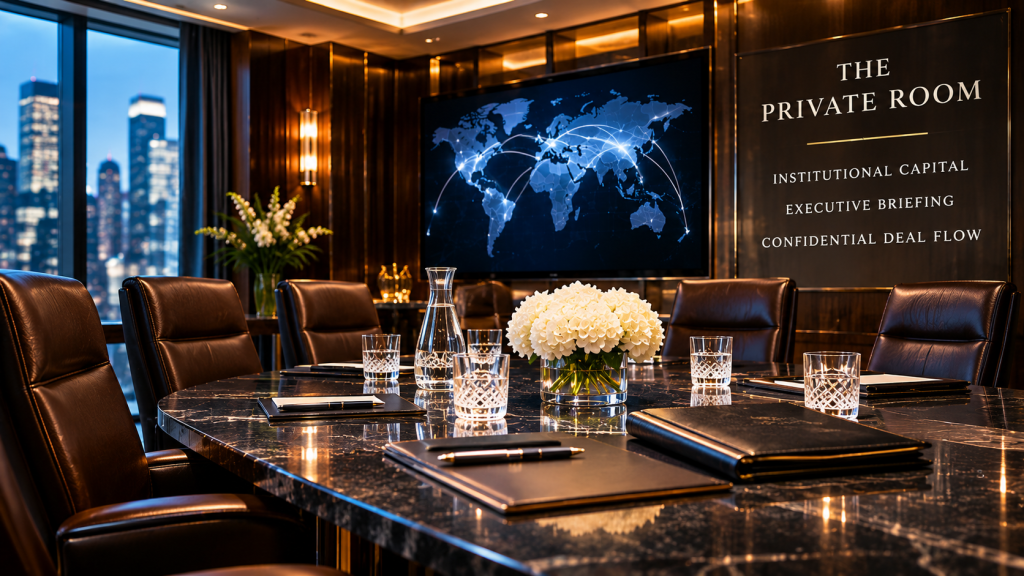
In the highest echelons of corporate deal-flow, visibility is no longer an asset; it is a liability. While the broader market remains fixated on digital reach and algorithmic scale, a quiet divergence is occurring among institutional leaders. The most significant transactions—nine-figure acquisitions, federal defense contracts, and legacy wealth allocations—are being pulled entirely off the grid. They are returning to the private room.
However, this return to physical convening exposes a critical vulnerability in the luxury market: the vast majority of premium venues are designed for aesthetics, not discretion. They lack the architectural and psychological frameworks required to host high-stakes institutional capital. This briefing examines the sociological shift driving corporate influence behind closed doors, the spatial psychology required to secure it, and the new data-driven standard for institutional environments.
I. The Collapse of Digital Trust in High-Ticket Commerce
The influencer bubble has popped for institutional capital. Over the last decade, brands became intoxicated by digital scale, operating under the assumption that reach equated to influence. That equation works for fast-moving consumer goods. It fails entirely for the enterprise.
You cannot secure a $50 million AI enterprise contract, win federal defense tech procurement, or cultivate multi-generational wealth for legacy luxury goods through a digital funnel or a viral social campaign. In high-stakes deal-flow, digital noise is a liability.
Today, undivided executive attention is the rarest commodity in commerce. As digital channels become saturated with synthetic content and automated outreach, institutional trust is suffering from a severe deficit. In response, ultra-high-net-worth (UHNW) leaders, AI founders, and government officials are executing a silent pivot. They are pulling their most valuable, high-leverage interactions entirely off the internet and returning them to the only environment they can control: the private room.
II. The Sociology of Space: The Physical Environment as a Negotiator
When capital gathers in a physical room, the environment acts as a silent negotiator. Every architectural choice either accelerates trust or creates friction.
True luxury in corporate hospitality is no longer defined by superficial aesthetics—crystal chandeliers or imported marble. Today, institutional luxury is defined by acoustic isolation, secure perimeters, and guaranteed discretion. When a defense contractor is briefing federal agencies on smart-grid EV software, or an AI startup is navigating an acquisition, the physical space must operate as a secure vault.
This is the sociology of space in practice. The physical environment dictates the psychological state of the executives inside it. The right spatial dynamics lower defensive barriers, foster candid dialogue, and ultimately accelerate complex, multi-million-dollar agreements. The wrong environment kills the deal before the terms are even discussed.
III. The Anatomy of an Institutional-Grade Space
The majority of venues—even five-star properties—fail the institutional standard. A standard hotel ballroom or generic private dining room is engineered for high turnover and public visibility, not corporate discretion.
An institutional-grade space is audited against strict spatial and psychological criteria:
- Acoustics and Seating Architecture: Echo and ambient noise trigger cognitive fatigue. A proper corporate convening space requires advanced acoustic dampening to ensure conversations remain localized and secure. Sightlines must be engineered so that the primary stakeholders hold the room’s visual gravity without distraction.
- Circulation and Executive Flow: How executives enter, move through, and exit a room dictates the power dynamics of the meeting. A single point of entry with restricted flow forces intentional networking, whereas multiple open exits create psychological instability and a rushed atmosphere.
- Lighting and Cognitive Focus: Harsh overhead lighting induces interrogation-style stress. Ambient, layered lighting reduces eye strain, maintains executive focus, and controls the pacing of multi-hour briefings.
IV. Real-World Blueprints: Where Capital Actually Gathers
The most powerful brands in the world already utilize this blueprint, operating highly restricted environments shielded from public view.
- The Legacy Blueprint: Consider legacy luxury brands like Rolex. They utilize highly restricted physical corporate suites—such as the Rolex 24 Lounge at Daytona—to cultivate multi-generational loyalty. They intentionally shield their top-tier clients from the public eye, relying on spatial exclusivity rather than digital exposure.
- The Defense & Tech Protocol: In Washington D.C. and Northern Virginia, a new standard of out-of-band, acoustically secure private dining and briefing rooms has emerged. Here, defense contractors and tech founders pitch federal agencies without fear of surveillance, interruption, or public record.
- The Modern Global Boardroom: In financial hubs like New York, London, and Dubai, the ideal UHNW corporate dining room operates more like a private intelligence facility than a restaurant, offering dedicated entrances, vetted staff, and environments that naturally meet the strictest institutional standards for privacy.
V. The New Standard for Institutional Hospitality
While institutional capital desperately wants to meet in private, a significant gap remains in the market. Until now, there has been no global, data-driven standard for identifying which venues are actually equipped for this level of elite corporate hospitality.
Mosnar Communications is establishing that standard.
For Venues: Exceptional spaces require institutional context. Venues that meet these stringent spatial and psychological criteria may apply for an institutional audit and consideration for The Luxury Corporate Venue Registry. Inclusion requires passing our spatial assessment and an IP placement fee of $12,500, positioning your venue as a verified asset for UHNW and B2B deal-flow. Submit Venue Interest Here
For Executives and Founders: To understand the frameworks driving modern corporate hospitality and spatial psychology, request The Briefing. Our proprietary intelligence feed equips your executive team with the sociological blueprints behind where global influence gathers. Request The Briefing Here