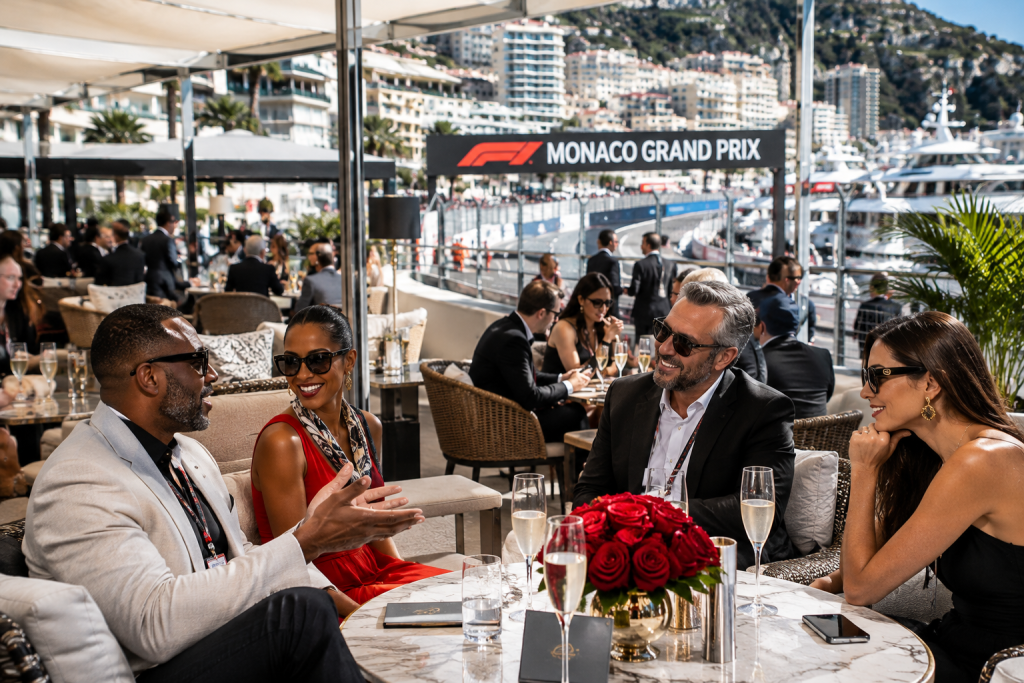
In the hierarchy of global wealth, the Monaco Grand Prix is the ultimate visibility trap. For four days in May, the Principality becomes the most densely concentrated hub of ultra-high-net-worth (UHNW) capital on earth. Yet, it is also the loudest, most chaotic, and most visually exposed environment in the luxury calendar.
While the global media and standard corporate sponsors fixate on trackside terraces, Paddock Club passes, and branded harbor yachts, institutional capital operates on a divergent spatial protocol. The true objective of Monaco is not to watch the spectacle; it is to leverage the gravitational pull of the race to execute nine-figure bilateral negotiations. Doing so in an environment generating 130 decibels of ambient noise requires extraordinary spatial engineering.
This briefing examines the sociological architecture of the Monaco Grand Prix, detailing how elite deal-makers transition from public exposure to absolute acoustic discretion, utilizing offshore sovereign vaults and high-altitude perimeters to close deals.
I. The Acoustic Liability of the Harbor
To understand corporate hospitality in Monaco, one must first understand the physics of the environment. The Formula 1 engine is a blunt instrument of acoustic disruption. During track sessions, the ambient noise in Port Hercule renders complex financial or strategic communication impossible.
For a consumer brand, shouting over engine noise on a branded trackside yacht is an acceptable cost of marketing. For an AI founder pitching a sovereign wealth fund, or a maritime logistics CEO finalizing an acquisition, cognitive fatigue and acoustic bleed are critical operational risks. You cannot negotiate a $50 million enterprise contract when you are forced to raise your voice.
Consequently, the highest tier of capital views the harbor strictly as a public relations staging ground. The Paddock and the trackside yachts are utilized for brief, visible handshakes—signaling presence and market dominance—before the principals immediately extract themselves to acoustically secure, out-of-band environments to conduct actual business.
II. The Superyacht as a Sovereign Vault
In Monaco, the position of a yacht dictates its function. Yachts moored in Zone 1 (trackside) are built for exposure. True institutional privacy requires a different spatial geometry: the offshore anchorage.
When UHNW wealth managers or legacy luxury executives need to secure absolute discretion, they utilize superyachts anchored out in the bay, accessible only via private tender. In this context, the vessel ceases to be a leisure asset and becomes a highly controlled, maritime intelligence facility.
- The Moat Effect: The water acts as an impenetrable physical perimeter. Uninvited foot traffic, paparazzi, and corporate espionage are neutralized by distance and controlled tender access.
- Acoustic Isolation: By anchoring beyond the breakwater, the chaotic noise of the circuit is reduced to a dull, manageable hum.
- Internal Zoning: Even onboard, the spatial geometry is rigidly tiered. The aft deck may host a curated cocktail reception, while the principal negotiations occur deep within the vessel in acoustically dampened, interior formal dining rooms, entirely shielded from exterior sightlines and marine VHF radio scanners.
III. The Altitude Advantage: The Off-Track Perimeter
For executives who prefer terrestrial stability, the ultimate flex of influence during the Grand Prix is entirely leaving the Principality.
While mid-tier corporate hospitality crowds into the Hotel de Paris or temporary harbor structures, institutional deal-flow moves vertically into the hills of Roquebrune-Cap-Martin, La Turbie, or Eze. These unbranded, fortified residential villas offer the highest degree of spatial privacy available during the race weekend.
By utilizing these high-altitude perimeters, hosts achieve total circulation control. Entry requires navigating private, gated roads, ensuring that every individual in the room has been thoroughly vetted. The architecture of these villas—thick stone walls, deep subterranean wine cellars converted into briefing rooms, and secure interior courtyards—provides complete acoustic and visual isolation. It is the ultimate display of spatial leverage: forcing the market to leave the epicenter of the spectacle to meet you in the quiet.
IV. The Anatomy of a Monaco Deal-Room
Whether on an offshore vessel or a high-altitude villa, an institutional-grade space during the Monaco Grand Prix must pass a stringent spatial audit:
- Acoustic Neutralization: The space must feature heavy, sound-absorbing textiles, specialized double-glazing, and structural mass to completely neutralize the high-frequency whine of the circuit and the low-frequency rumble of harbor helicopter traffic.
- Vetted Circulation: The venue must allow for seamless, private ingress and egress. If a principal must walk through a crowded, public hotel lobby to reach a private dining room, the venue fails the institutional standard.
- Cognitive Respite: The lighting and aesthetic must stand in stark contrast to the aggressive, sun-drenched sensory overload of the track. Low ambient lighting, cool temperatures, and minimalist, circular seating architecture lower defensive barriers and restore executive focus.
V. The New Audit for Spatial Prestige
The demand for verified, acoustically secure private spaces during the Monaco Grand Prix vastly outstrips the supply. A venue can no longer qualify for an elite tier of corporate hospitality based solely on a view of the hairpin turn or proximity to the harbor.
The industry requires an audit.
For Venues: Exceptional spaces require institutional context. Properties and vessels that meet these stringent architectural, acoustic, and spatial parameters can apply for an institutional assessment and listing in The Luxury Corporate Venue Registry. Inclusion confirms that your space meets the required $12,500 assessment threshold, recognizing your property as a trusted, secure site for high-value B2B and UHNW deal-flow.
For Executive Leaders and Teams: Understanding how to secure spatial control and orchestrate high-stakes gatherings during chaotic global events is critical to protecting your organization’s influence. Subscribe to The Briefing for weekly data, trends, and analytical insights into the sociology of private spaces and life inside the closed-door room.